
Éxxita hosts the presentation of Cotec's Circular Economy Report
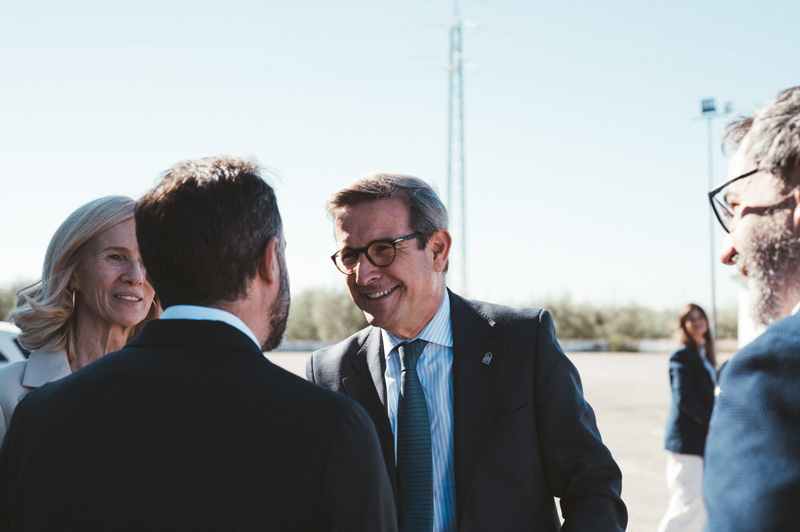
On November 3, we had the honor of hosting the presentation of the Cotec Report on the Circular Economy, prepared by the Cotec Foundation for Innovation, at our Circular Innovation Hub in Bollullos de la Mitación (Seville).
The meeting brought together institutional, business and academic leaders from all over Spain to reflect on the present and future of the circular economy and share experiences that contribute to accelerating the transition to a more sustainable production model.

A report to measure the evolution of the circular economy
Since 2017, Cotec has been analyzing the state of the circular economy in Spain, as well as the policies and strategies that drive its development from different administrative levels.
The 2025 edition represents an important step forward by incorporating systemic indicators aligned with the European framework, with the aim of measuring not only efficiency in the use of resources, but also their environmental, social and economic impact.
The report also includes a pioneering study on the adoption of circular practices by Spanish companies, based on the criteria of the European Corporate Sustainability Reporting Directive (CSRD).
This approach allows a better understanding of the degree of integration of sustainability in business strategy and anticipates the challenges that will mark the coming years.
Main conclusions of the Cotec Report on Circular Economy 2025
The report highlights that Spain is making progress in the circular transition, although at a pace that is still insufficient to meet European recycling and landfill reduction targets.
Among the most relevant data:
-
Resource productivity reached 3.53 euros per kilogram in 2023, placing Spain among the best performing countries in the EU.
-
However, the country will not reach the 55% municipal waste recycling target set for 2025, and risks missing the maximum landfill target of 10% set for 2035.
-
The study underscores the importance of scaling real solutions beyond pilot projects and the need for economically viable and environmentally preferable models.
-
The CSRD and the new European Sustainability Reporting Standard (NEIS E5) are presented as key tools for improving corporate transparency and accountability.
-
Finally, Cotec emphasizes collaboration between companies, administrations and citizens as the basis for effective circularity, supported by innovation, training and fiscal policies that promote change.
In Cotec's words, the circular economy in Spain "requires moving from awareness to structural action", with a shared vision that has an economic, social and environmental impact.
A day of shared knowledge
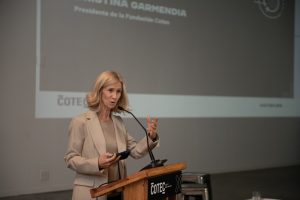
The session was attended by Cristina Garmendia, President of the Cotec Foundation; Alejandro Dorado, Commissioner for the Circular Economy of the Ministry for Ecological Transition and the Demographic Challenge; and Jorge Paradela, Minister of Industry, Energy and Mines of the Regional Government of Andalusia.
Success stories andbest practices in waste management from Atlantic Copper, Urbaser, Econward and Veolia were also presented, together with the experience of the Valladolid City Council and the academic contribution of Gemma Patón (UCLM) and Luis Jiménez (ASYPS).
These interventions highlighted the essential role of public-private collaboration in the consolidation of a circular economy that combines innovation, profitability and positive impact.
Éxxita as the epicenter of the circular economy
The choice of Éxxita as the venue for the presentation responds to the recognition of our role as a member of Cotec and a national reference in circular economy applied to the technological field.
We thank the Cotec Foundation for the trust placed in us and all the people and institutions that accompanied us on this day.
At Éxxita we will continue to work to prevent the waste of value in all its forms, applying knowledge, technology and a regenerative vision to build a fairer and more sustainable production model.
Because we are convinced that when knowledge is shared, it accelerates change.